


By Oladele Ogunsola
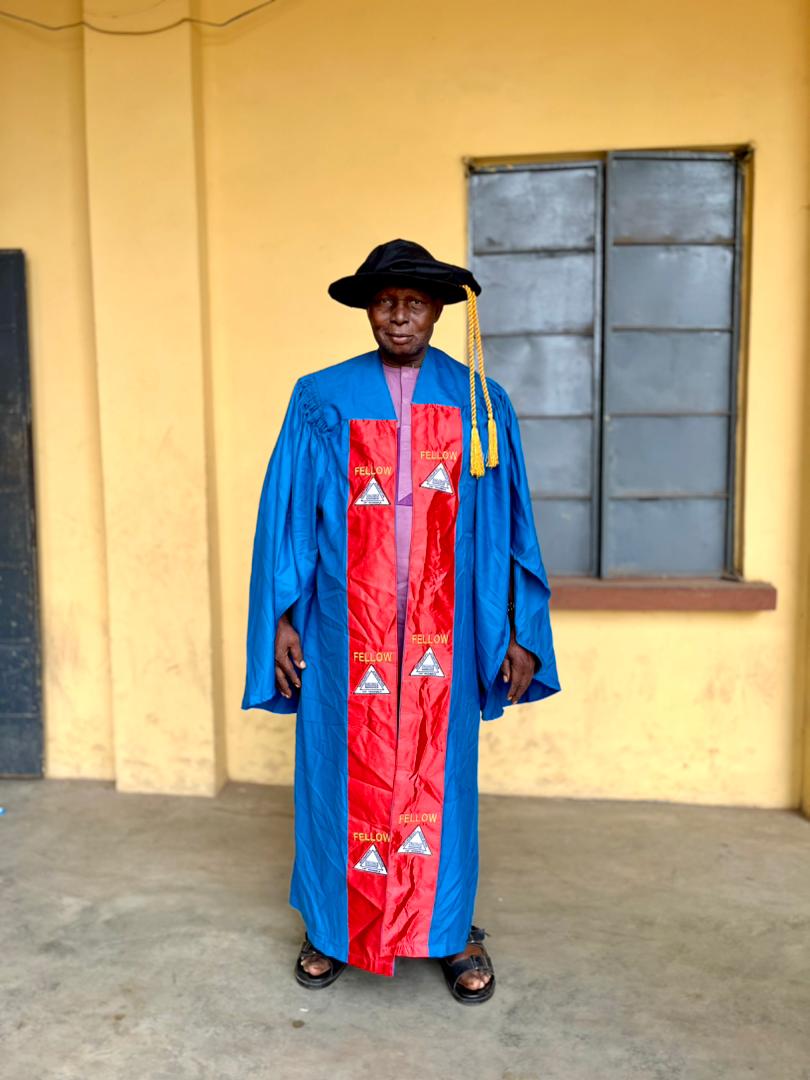
Prof. Aderemi Abass Adedibu, the eldest son of the late strongman of Ibadan politics, High Chief Lamidi Ariyibi Akanji Adedibu, needs little introduction to anyone who knew the late “Alaafin Molete.” At first glance, the resemblance between father and son is striking. Yet that is where the similarity largely ends.
Unlike his father, who was renowned for his boisterous style and commanding presence in politics, the academic giant is quiet, reserved and deeply reflective.
Unassuming yet self-confident, Prof. Adedibu believes that if he can achieve his goals on his own merit, there is no need to parade his father’s influence like a badge of honour. In this encounter with our reporter, Oladele Ogunsola, he speaks about carving his own path outside his father’s political shadow, the values that shaped him, and other issues concerning the Adedibu family.
A Scandal-Free Family After Their Father’s Death
“You hardly read any negative story about our family in either the traditional or social media almost 18 years after our father’s death. That is because we do not practice dictatorship within the family.
“In many families, the execution of the will of such a prominent figure often leads to disputes. But that has never happened in ours. At the time of our father’s death in 2008, we were 19 children. Sadly, we have since lost four siblings, but none of us considers the other inconsequential. That is why there is harmony among us.”
Living a Modest Life Outside His Father’s Influence
“I realised very early in life that whatever position or stature my father attained would not last forever. It would only be for a moment. I therefore asked myself: what would become of me when his reign ended?
“Interestingly, my father never indulged any of us. He ensured we went to school and did everything within his power to help us pursue our dreams. Along the way, I discovered that I had the capacity to achieve whatever I set out to achieve on my own.
“So, if I could become whatever I wanted without relying on the badge of his influence, why should I bother? My modest lifestyle is simply my nature. As they say, empty barrels make the loudest noise. The path I chose demands focus and concentration, not the boisterous style many people expected.”
His Aversion to Active Politics
“If you mean full-time involvement in politics the way my father practised it, then yes, I am averse to politics. But if you mean being politically conscious, then no, I am not.
“At the moment, I hold a political appointment as a member of the pioneer Governing Council of Emmanuel Alayande University of Education in Oyo State.
“But having witnessed my father’s experience in politics before the glamour, influence and popularity came, I was never fascinated by it. When people later started chanting his name across the state and beyond, I often shook my head because they were seeing the glamour, not the struggles he endured.”
The Travails Before the Glamour
“My father did not begin politics during the SDP/NRC era of the early 1990s when he eventually blossomed, especially during the presidential bid of the late Chief MKO Abiola under the Social Democratic Party (SDP). That was when the glamour and influence became visible until his death in 2008.
“But what about the years before that?
“In the 1964 elections, he contested under the United Progressive Grand Alliance (UPGA). His aim was to use the platform to work for the release of the late Chief Obafemi Awolowo, who was then serving a 10-year prison sentence for treasonable felony.
“He lost the election. The painful part was that he had borrowed the money he used for the campaign. Worse still, he had told the lender the money was meant for my school fees. In the end, he lost the election and could not pay my fees.
“For some time, he had to go into hiding from creditors in a secluded section of our old house before he later built the famous Molete residence. Only a few family members knew where he was hiding then. At that time, nobody knew him as the ‘strongman of Ibadan politics.’”
Prof. Adedibu recalls another incident when his father was put in charge of coordinating pilgrims for Hajj.
“The man he sent to Kano to process travel arrangements lost the pilgrims’ passports and the funds. While that crisis was unfolding, my admission letter to study in the United States arrived.
“I informed my father around 8 p.m. Barely two hours later, security agents arrived and arrested him over the Hajj issue. He was detained alongside Alhaji Dantata, the grandfather of Aliko Dangote.
“Despite his predicament, he still found a way to raise money for my trip abroad. Having witnessed such experiences, I never saw politics as my own calling.”
Shoes Too Big to Fill
“People say we are born equal but not equally talented. My father was naturally a welfarist from childhood. As a schoolboy, he often took his friends to his mother’s house to feed them.
“So when he later practised what people called ‘amala politics,’ it did not start suddenly; it had always been part of his character.
“If he believed you had the potential to win an election, he would support you wholeheartedly. From contracts and patronage he received, he would fund candidates and distribute resources openly among his followers.
“He was also a philanthropist who supported people beyond his political circle. Now ask yourself: where is the politician today with all these attributes? The shoes he left behind are simply too big for anyone to fill.”
Products of the Molete Political School
“My father had many political protégés who attended what people called the ‘Molete political school.’ But attending a school is one thing; graduating from it is another.
“In his days, he would never support someone to win an election only for that person to abandon the same people who voted for him. If complaints reached him, he would call such a person to order.
“If today’s leaders truly cared about the welfare of the people, things would not be this difficult in the country.”
The Few Political Loyalists Still Close to the Family
“Many of his political associates have gone their separate ways. But three people still remain very close to the family: Ambassador Taofeek Oladejo Arapaja, Hon. Aderemi Ayodele, and Hon. Akeem Ige.
“They are not just political associates; they are part of the family.”
Omission of Adedibu’s Name from Oyo @ 50 Honours
“Yes, my father’s name was conspicuously omitted from the list of awardees at the Oyo @ 50 celebration. I considered it unfair and brought it to the attention of the planning committee chairman, Hon. Saheed Fijabi.
“Sadly, it wasn’t only my father’s name that was omitted. Other Ibadan giants such as the late Chief Augustus Meredith Adisa Akinloye and the late Chief Richard Akinjide, SAN, were also excluded.
“However, my concern was my father’s legacy. I know what to do to ensure he receives the recognition he deserves, but I will not discuss that in the newspapers.”
Nigeria’s Faulty Educational Policies
“As an educationist who spent his career in the system, I believe Nigeria is often too quick to adopt foreign ideas without considering whether they suit our environment.
“A good example is the 6-3-3-4 education system. It was actually a local policy from a county in the United States—equivalent to our local government—not even a statewide policy.
“It had existed since about 1846 without being adopted widely even within the U.S. Yet Nigeria imported it wholesale and imposed it nationwide.”
On Continuous Assessment and Nepotism
“The fear of abuse is understandable, but Nigerians appreciate transparency when they see it. The key is proper orientation and appointing people based on merit.
“Anyone who lobbied for a job will always be afraid of losing it and may compromise standards.”
He recalls an incident during his time as National Coordinator of the Junior Engineers, Technologists and Scientists (JETS) programme in the Federal Ministry of Education.
“A powerful politician tried to smuggle his school into the national competition list. I disqualified the school because it did not qualify.
“He reported the matter to the Minister of Education, but I stood my ground. Two weeks later, the same man met me and said, ‘You are the type of person Nigeria needs.’ That is the confidence merit gives you.”
The Man, Aderemi Adedibu
Prof. Aderemi Adedibu was born in Ibadan South-West Local Government Area of Oyo State to the late High Chief Lamidi Ariyibi Akanji Adedibu and Alhaja Misitura Aduke Ajitoni Adedibu.
He attended Children’s Home School, Ibara, Abeokuta, for his primary education and Ibadan Grammar School, Molete, for his secondary education.
He later moved to the United States, where he earned a Bachelor of Science degree in Chemistry and Mathematics from Indiana University–Purdue University, Indianapolis. He obtained a Master’s degree in Educational Psychology from Indiana University, Bloomington.
Prof. Adedibu went on to earn multiple doctoral degrees: a PhD in Religious Education (1980), a PhD in Chemistry Education (1981), both from Indiana Christian University, and later a PhD in Public Administration from Columbia State University in 2009.
A licensed teacher in the State of Indiana, he worked as a toxicologist at Wizard Memorial Hospital and as Chief Chemist with the Indiana State Board of Health between 1976 and 1981.
He later served in several key academic and administrative roles in Nigeria, including Registrar and Dean at the Federal College of Education, Kontagora, and pioneer Registrar at the Federal College of Education, Obudu.
Prof. Adedibu retired from the Federal Ministry of Education in 2013 after decades of service and has since devoted his time to mentoring young Nigerians through science and technology initiatives.
Married and blessed with children, he continues to contribute to education and youth development while maintaining the quiet, disciplined life he chose long ago—far from the political spotlight that once surrounded his famous father.