



By Ayo Bamidele
June 20 is fast approaching, and the political temperature in Ekiti State is rising; but not because of vibrant campaigns or electrifying rallies. Instead, internal wrangling across major political parties is casting a long shadow over the forthcoming off-cycle governorship election.
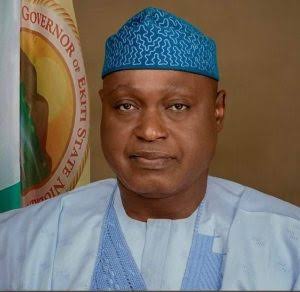
By October 17, incumbent Governor will mark four years in office, necessitating a fresh mandate from the electorate. The (INEC) has formally set the stage, releasing guidelines and the final list of candidates cleared to contest.
However, controversy trailed the publication. Notably absent from the list was the candidate of the Peoples Democratic Party (PDP), Dr. Wole Oluyede, whose disqualification has plunged the opposition into fresh legal and political turmoil. The PDP has since filed a notice of stay of execution and an appeal against the High Court judgment that knocked out its flag bearer.
A Crowded but Fractured Field
INEC’s list confirms that 12 political parties will feature in the contest, including the (APC), (LP), (NNPP), (ADC), (ADP), (ZLP), and (YPP), among others.
Governor Oyebanji, 58, will contest on the All Progressives Congress (APC) platform with Monisade Afuye as his running mate. The Labour Party (LP) is presenting Olajuyin Ikusayede Gbegbe Oyebanji, while younger contenders like 35-year-old Abegunde Ayobami Blessing of the New Nigeria Peoples Party (NNPP) and 36-year-old Akande Oluwasegun Samuel of the African Action Congress (AAC) add generational contrast to the race.
INEC’s documentation also reveals a striking disparity in educational qualifications among candidates and deputies, ranging from primary school certificates to doctorate degrees, fueling debate among voters and analysts.
Yet, despite the formal kickoff of the electoral process and the lifting of the campaign ban, political activities across the state remain unusually muted.
APC: Crisis Within the Ruling Ranks
The APC, though dominant at both state and federal levels, is battling internal dissent that threatens to undercut its electoral advantage.
The disqualification of aspirants Abimbola Olajumoke and Engineer Kayode Ojo by the party’s national leadership continues to generate ripples. Both have challenged their exclusion in court, with Ojo’s supporters reportedly affected by membership register adjustments that further deepened divisions.
From ward to state level, the party remains polarized. Billboards, posters, and campaign convoys are conspicuously absent, a telling sign that reconciliation efforts have yet to yield tangible results.
For now, the APC banks on incumbency and structural dominance. With control at state and federal levels, and with President in office, the party hopes its political machinery will outweigh internal fractures.
PDP in Disarray
If the APC is bruised, the PDP appears battered. The party’s crisis predates the current legal setback. Internal divisions, widely attributed to lingering political tensions from the era of former Governor , have weakened its grassroots strength.
The court case filed by one of its governorship aspirants further compounds its instability, leaving the party struggling to mount a coherent challenge.
Minor Parties, Limited Momentum
Other contenders face structural limitations. ADC’s candidate, Dare Bejide, a former PDP stalwart, may struggle to transcend his party’s modest footprint in the state.
David Opeyemi Falegan of the Accord Party (AP) has leveraged social media and humanitarian outreach, such as free distribution of fuel and gas, to build visibility. Yet, analysts question whether online enthusiasm can translate into electoral muscle.
The Road to Oke Ayoba
With four months to go, Ekiti’s political landscape is paradoxically active in courtrooms but quiet in the streets. The absence of visible statewide campaigns underscores the deep internal uncertainties plaguing major contenders.
For the APC, the path to the Oke Ayoba Government House in Ado Ekiti appears smoother—if, and only if, it resolves its internal disputes swiftly. For the PDP and other opposition parties, unity and clarity of purpose remain urgent tasks.
As June 20 draws nearer, one truth stands out: in Ekiti’s off-cycle election, internal cohesion may prove more decisive than campaign rhetoric.